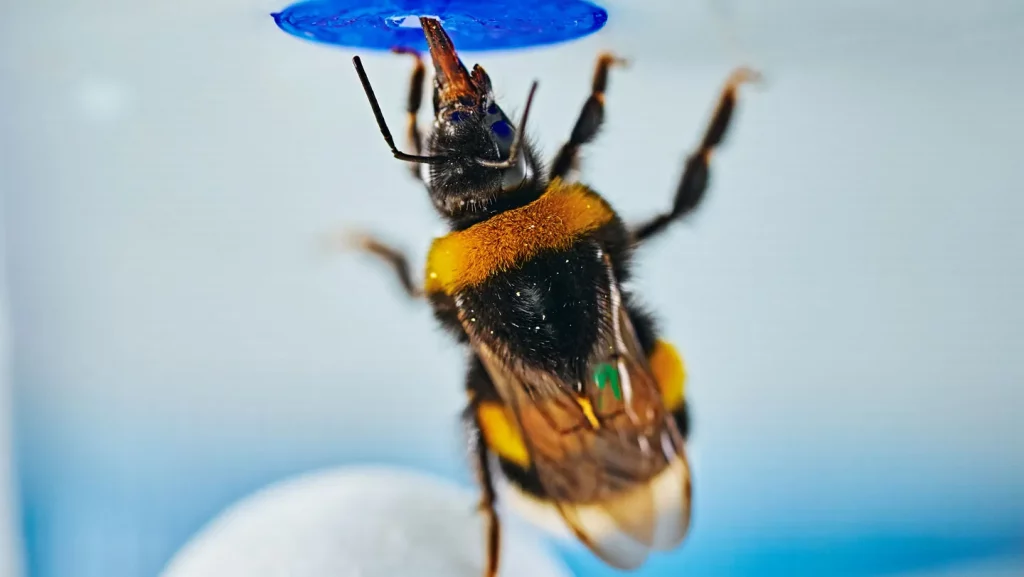
Picture a bumble bee in a small arena. There’s a blue flower on the ceiling, full of sugar water, with no way to reach it from the floor. A little ball sits nearby. The bee rolls the ball under the flower, climbs on top, and helps itself. Nobody trained it to do that. It just… figured it out.
That’s the headline finding from a new paper in Science [1] from Olli Loukola’s lab at the University of Oulu, with colleagues in Helsinki and Turku. And the headline is genuinely cool. It’s an insect pulling off the kind of trick Wolfgang Köhler’s chimpanzees became famous for a century ago, stacking boxes to reach a hung banana. A brain about the size of a poppy seed, running on roughly a million neurons against our 86 billion, doing something we assumed was reserved for big-brained animals.
But the headline is the least interesting part. The interesting part, and the part most science coverage skips, is how you get from “a bee did a neat thing once” to “bees can solve novel problems.” That gap is where the actual science lives, and this is where the creativity of science comes from. How to ask the right questions. It’s the part we aim to teach our students, and honestly think it should be discussed more in classes.
First, eliminate all the boring reasons
Here’s the mindset that separates a fun anecdote from a finding. Before you get to claim anything exciting, you have to kill every dull explanation for what you saw.
A good study is mostly a list of boring explanations the researchers ruled out.
Watch how this team did it.
“Maybe it was a lucky accident.” A bee blundering around might shove a ball into the right spot by chance. So the result can’t rest on one lucky bee. The team used bees that were completely naïve, never trained on the solution and with no prior experience combining objects, and they looked for the behavior reliably rather than once. Lead author Akshaye Bhambore put it plainly: the bees solved a completely new task without training and without trial and error.
“Maybe it’s just play, or trial-and-error.” Bumble bees really do play with balls, a finding from this same group. So “play that happened to work” is a live alternative, and so is slowly learning by accident over many tries. The experiments were built to separate spontaneous solving from both, by checking whether naïve bees produced the solution directly instead of stumbling into it over dozens of attempts.
“Maybe the bee is just chasing what it can see.” This is the big one, and it’s the control worth teaching. Maybe there’s no plan at all. Maybe the bee fixates on the blue flower and nudges the ball around until the reward drifts within reach. That would look impressive while being nothing more than steering toward a visible target.
So they hid the flower.
In their most demanding experiment, the flower was not visible from where the ball started. The bee couldn’t see its goal while pushing the ball. It had to move the ball to the correct side based on where the flower had been, then climb up to it. With nothing to steer toward, a bee running on pure visual feedback should have been stuck.
The bees solved it anyway.
That is the difference between reacting to the world in front of you and holding a goal in your head. It is why Loukola calls it true goal-directed behavior.
What the bee had to know already
One more part of the experiment is worth paying attention to.
The bees were never taught the solution, but they did need two unrelated bits of experience going in: that a blue flower means a reward, and that the ball is a harmless thing worth touching. Take away either one and the trick falls apart. Without the reward association, as Loukola puts it, blue means nothing.
Building the experiment this way lets the researchers say something precise: the bees combined two things they already knew into a brand-new action no one showed them.
That is a stronger and more careful claim than “bees are smart.”
And notice what the scientists refused to say. “We are not claiming that bees think like humans,” Loukola told reporters. Knowing exactly what your experiment does not prove is part of the craft, not a hedge.
This is also why the bee result feels so timely. We are living through a moment when giant AI models get most of the attention, and for good reason. The frontier systems are astonishing. But I often find myself just as amazed by the tiny models, the ones small enough to run on a phone or laptop. They are vastly smaller than the biggest systems, yet they can still do useful, flexible, surprising things.
That is the same lesson the bee keeps pushing back into view. Intelligence is not only about how much hardware you have. It is about what the system can do with the hardware it has.
A bee does not need a human-sized brain to combine “blue flower means food” with “ball is something I can move” and turn those two facts into a new solution. The impressive part is not the number of neurons. It is the organization of the behavior.
That makes the experiment more interesting, not less. The bee is not a tiny human, and it is not running a miniature version of our mind. But it is doing something flexible with a nervous system so small we are forced to ask a better question: not “How big is the brain?” but “What computation is this little brain actually capable of?”
You can practice this with a fish tank
Here’s the good news for a classroom. You don’t need a bee arena in Finland to do this kind of thinking. You need a question and the discipline to rule out the dull answers. We know, because one of our students did exactly that with a laser pointer.
A few years ago Sofia Eisenbeiser, then an undergraduate research fellow with us, noticed one of our African cichlids chasing a laser dot around its tank. Instead of posting a cute video, she asked the scientist’s question: do other fish do this, and does it mean anything? She shined red, green, and blue laser dots into dozens of aquariums and carefully scored the behavior. The result, published in the journal Animals [2] with Sofia as lead author, covered 66 species. Nearly 90% chased the dot, tiger barbs most of all, many preferred red, and their interest faded after about two weeks, the way a kid tires of a new toy.
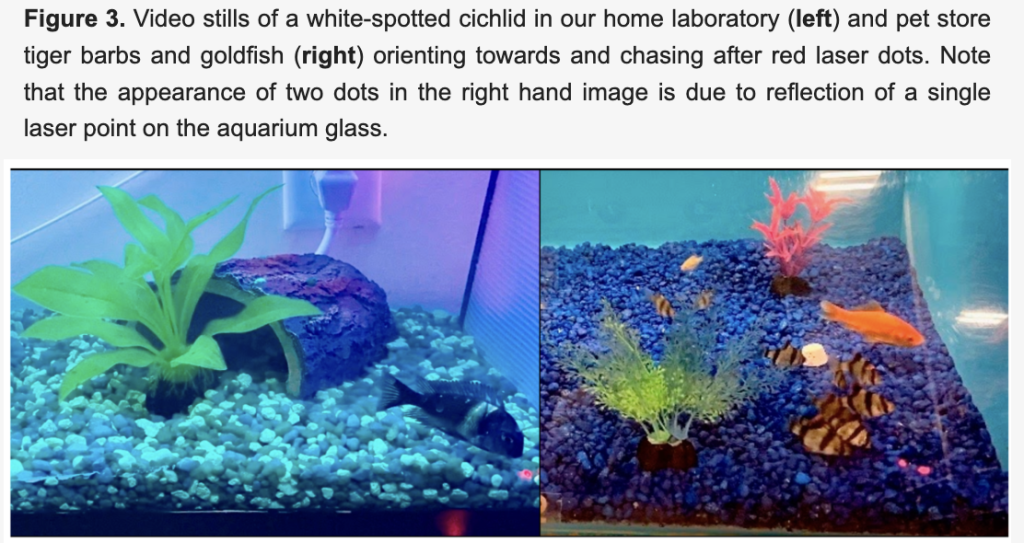
The part we are proudest of is the part that doesn’t make headlines. Before she switched on a single laser, Sofia recorded each fish’s normal behavior. That baseline is the control. Without it you can’t say the laser changed anything… the fish might just be doing ordinary fish things. And she didn’t overclaim. Whether laser-chasing truly counts as “play” depends on a strict checklist of criteria, and the paper treats that as an open question instead of declaring victory. Same discipline as the bee team, on a much smaller budget.
That’s the experiment we would hand to students. It costs a tank and a laser pointer, and the valuable part is free: record your baseline, define your behaviors before you start counting, watch for the animal getting bored, and ask what boring explanation you would have to rule out before you believe your own result.
None of this requires knowing the answer before you start. The figuring-out is the fun part, and being unsure is allowed.
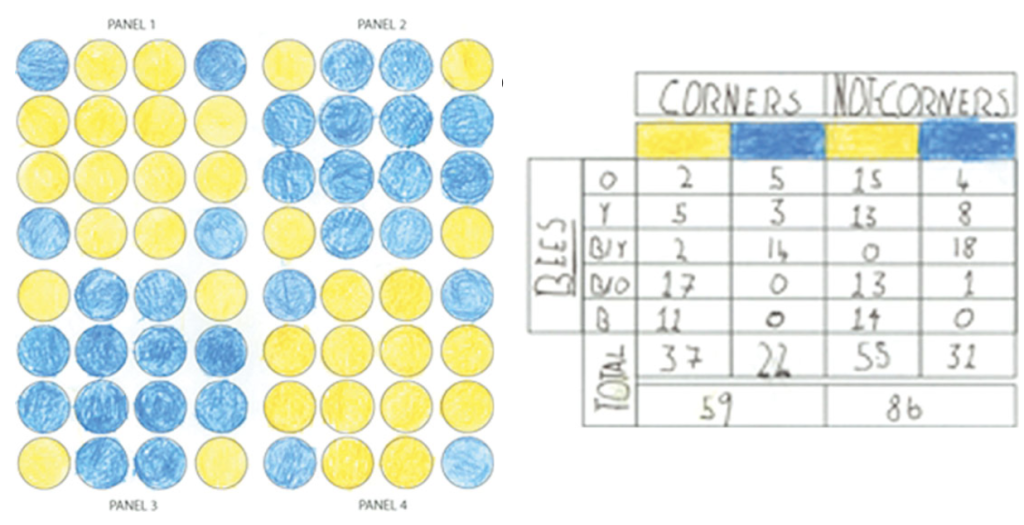
Back in 2010 a class of 8-to-10-year-olds at Blackawton Primary School in Devon did exactly that: they came up with their own questions about how buff-tailed bumblebees (the same species up top) use color and pattern to choose flowers, designed the experiments, drew their results in colored pencil, and published the whole thing in the Royal Society’s Biology Letters [3]. As the kids put it, science is fun “because you get to do stuff that no one has ever done before.”
So point a laser into a fish tank and watch carefully. The fun is real. The rigor is what turns it into science.
Read Sofia’s open-access paper to see exactly how she set it up ?
[1] Bhambore et al., “Spontaneous problem-solving in bumble bees,” Science 392, 1046-1049 (2026), DOI: 10.1126/science.ady1618; University of Oulu press release and video.
[2] Eisenbeiser, Serbe-Kamp, Gage & Marzullo, “Gills Just Want to Have Fun: Can Fish Play Games, Just like Us?”, Animals 12(13), 1684 (2022), DOI: 10.3390/ani12131684.
[3] Blackawton, P.S., et al. “Blackawton bees.” Biology Letters 7(2):168–172 (2010), DOI: 10.1098/rsbl.2010.1056.