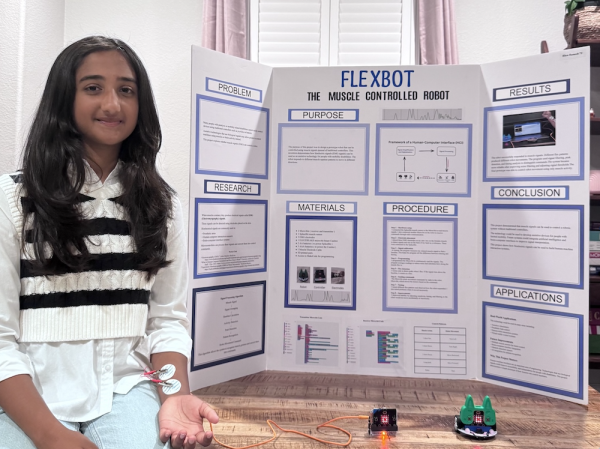
Every once in a while, an email lands in our inbox that reminds us exactly why we do this work. Last week, one came from Rhea R., a 7th grader who took home third prize at her middle school science fair with a project she calls FlexBot: a robot car you drive with your muscles.
No joystick. No remote. Just electrodes on her forearm, a SpikerBit, two micro:bits, and a control scheme she designed and debugged herself:
– One long hold = forward
– Two flexes = right
– One short flex = left
– Three flexes = backward
She built it. She coded it. She fought through the noise, literally, until it worked.
Watch Rhea explain FlexBot in her own words:
It started with a book
Rhea’s path into neuroscience didn’t begin with a textbook or a lab. It began at age 11, with a novel: Out of My Mind by Sharon M. Draper, a story told from the perspective of a girl with cerebral palsy whose brilliant mind is locked behind a body that won’t cooperate. That book stuck with Rhea. It made the brain feel less like an organ and more like a place where a whole person lives.
In 6th grade, she ran her first science fair project on the Stroop Effect, the classic experiment where your brain has to fight itself to read the word “RED” printed in blue ink. She got hooked on the idea that the brain doesn’t just think: it also negotiates, conflicts, decides.
Then she found us.
From DIY prosthetic hand to FlexBot
After building one of our DIY prosthetic hand kits, Rhea started asking a bigger question: what if brain-controlled tech wasn’t just about replacing movement for people with paralysis or mobility differences, but about creating new ways to move?
That question became FlexBot. From first sketch to working prototype, the project took about two months. The first month was research, brainstorming, and writing the code for smaller components. The second month was when everything had to come together: the hardware, the software, and the messy real-world signals that refused to behave.
The bug that almost broke it
Here’s the moment FlexBot finally clicked, in Rhea’s own words:
“I had already programmed it to move left, right, and backward using different muscle flex patterns, but every time I tried to make it move forward, the robot would spin in circles instead. That part was especially frustrating because the issue wasn’t mechanical, it was the noisiness of bioelectric signals. After repeatedly testing the system, studying my code, and analyzing the signal patterns, I realized that the program was interpreting a long muscle hold as multiple short squeezes. I eventually fixed the issue by adjusting the timing, sensitivity, and filtering logic in the program so the robot could better differentiate between quick muscle bursts and long holds.”
Read that paragraph again. That’s a 7th grader debugging signal processing.
And the payoff?
“The most memorable moment came right after I solved it: I was able to drive my fully working prototype from my room all the way to my dad’s office using only my muscle signals, while my younger brother followed the robot in complete awe and excitement.”
We’re going to be thinking about that image, a kid driving a robot car down a hallway with her own muscles, her little brother chasing behind it, for a long time.
A note on doing it (mostly) yourself
Rhea worked through this project largely on her own, drawing on previous block-coding experience and learning new skills from YouTube tutorials and online research. When she got stuck, her mom didn’t hand her the answer: she nudged her toward possibilities and encouraged her to test her way through. That’s the kind of support that builds real scientists.
What Rhea wants other kids to know
We asked Rhea what she wished more kids her age understood about neuroscience. Her answer:
“Most kids (and even adults) think of neuroscience as only a medical science, when in reality, it is a science that can be applied to everyday life. Neuroscience helps explain things like procrastination, habit formation, stress, emotions, focus, learning, and motivation. This is especially important for kids our age because our brains are still developing and changing. That means we are very adaptable and capable of learning quickly, but it also means we can sometimes make impulsive decisions. Understanding how the brain works can help us build better habits, manage stress, improve learning, and make smarter decisions.”
We didn’t write that. A 12-year-old did.
Why this matters
We build tools so curious people can do real neuroscience without a million-dollar lab. But the tools are just the starting point. What matters is what people do with them. Rhea took a SpikerBit, two micro:bits, a robot car, a book that moved her, and a question worth answering — and made something genuinely new.
To Rhea: congratulations on third prize, and thank you for letting us share your story. To Rhea’s parents: thank you for raising a kid who reads books about empathy and then goes and builds robots with it. We can’t wait to see what she does next.
To everyone else reading this: what’s your FlexBot?